
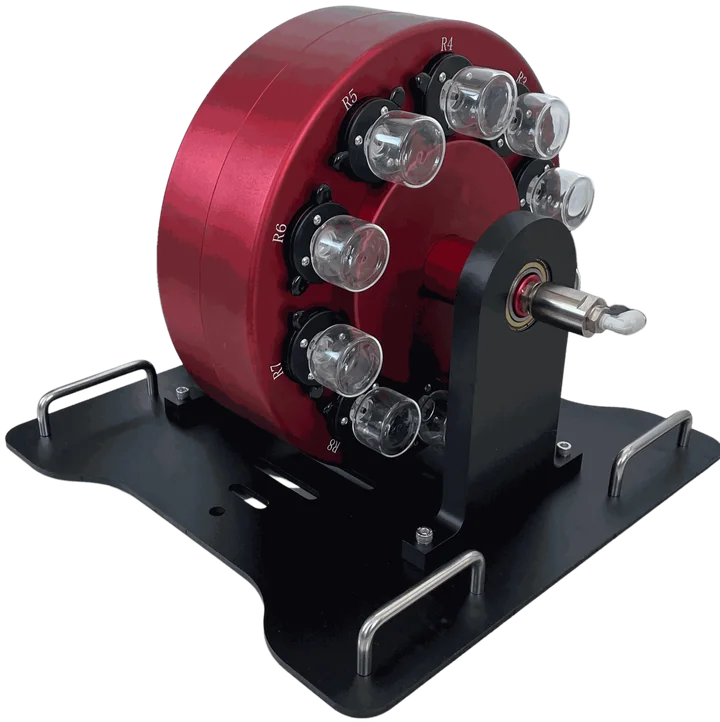
- Twenty thin-wall glass culture bottles are mounted on a pluggable single-axis rotator inside a temperature-controlled chamber. As the rotator turns, a humidified O₂/N₂/CO₂ mixture is delivered through its internal gas channels directly and continuously into every bottle.
- This continuous-gassing rotator method is a classic approach for organogenesis-stage embryos: published protocols culture rat embryos for about 96 hours from gestational day 9.5 and for 72 hours from day 11.5 (Osumi-Yamashita et al., 1997).
- Gas ratio, flow, positive pressure, temperature and rotation speed are all set digitally. At least 10 parameter groups switch automatically on a timeline, so staged gas changes no longer depend on manual regassing.
- Suited to embryo manipulation and developmental biology experiments, studies of mammalian embryo metabolism, embryotoxicity and teratogenicity testing of drugs and chemicals, and long-term dynamic culture of stem cell-derived embryo models.
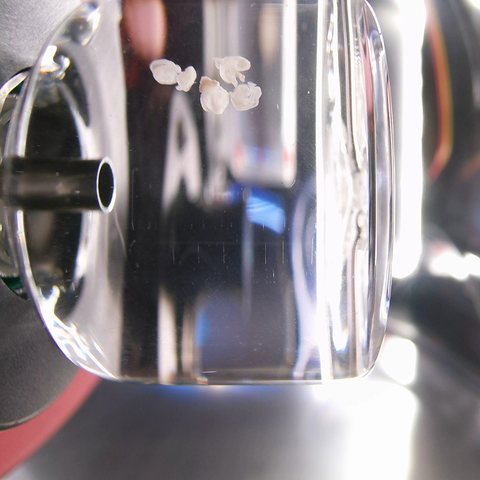
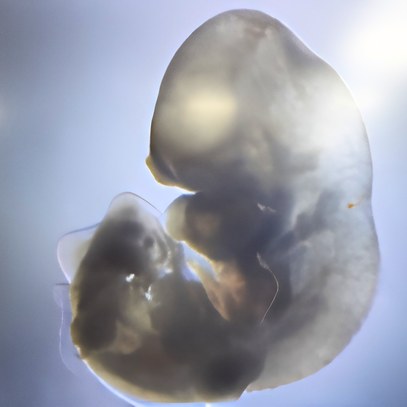
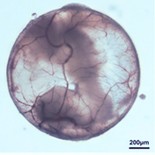
Example images from preliminary culture runs of mouse whole embryos or stem cell-derived embryo models in user laboratories. Left: samples in a culture bottle (EmbryoLive20); center: embryo; right: yolk sac, scale bar 200 μm. Results for other samples depend on the actual experiment.
Representative culture protocols
Culture protocols for postimplantation rat embryos (Sprague-Dawley), compiled from Table 1 of Osumi-Yamashita et al. (1997), whose data were obtained with a continuous-gassing rotator system. Use them as a starting point for experimental design.
| Explantation (gestational day)a | Initial somites | Medium per embryo (ml)b | O₂ concentration over timec | Culture period | Final somites |
|---|---|---|---|---|---|
| 9.5 | 0 | 1 | 5% (0 h–) → 20% (36 h–) → 60% (48 h–) → 95% (60 h–) OYS at 72 h | 96 h | 40+ |
| 10.5 | ~10 | 1.5–2 | 5% (0 h–) → 20% (12 h–) → 60% (24 h–) → 95% (36 h–) OYS at 48 h | 72 h | 40+ |
| 11.5 | 22 | 2.5–3 MC at 48 h | 95% OYS at 24 h | 72 h | ~50d |
| 12.5 (OYS) | 34 | 3e MC at 24–36 h | 95% | 60 h | ~50d |
- Based on the authors' data using Sprague-Dawley rat embryos and a continuous-gassing rotator whole embryo culture apparatus.
- Medium: 100% rat serum containing 2 mg/ml glucose; at least 2 ml per bottle in the original study.
- The gas mixture contains 5% CO₂ with N₂ as the balance. Gas changes may be shifted up to 3 h earlier or later, but high oxygen is toxic to embryos before neural tube closure.
- Tail somites stop increasing because the tail degenerates.
- Replaced with serum diluted 2–3 times with Tyrode's solution.
OYS: opening of the yolk sac membrane; MC: medium change. The authors note that the protocol also applies to mouse embryos at the same developmental stage, with lower oxygen requirements and less medium; mouse embryos developed somewhat less well than rat embryos, possibly because the serum came from a different species.
Running staged protocols on WEC001
Save the O₂/N₂/CO₂ ratio, flow, pressure and rotation speed of each stage as one parameter group (at least 10 groups are available). The controller switches groups at the scheduled times and logs the actual values for later review.
This table summarizes a published protocol for reference only; the data were not obtained with WEC001. Optimize conditions for your strain, embryonic stage and objectives. For high-oxygen stages, please confirm the gas supply configuration and laboratory safety requirements with our technical team.
Rotary Whole Embryo Culture Apparatus WEC001-GT6 Discovery · with spinning perfusion module
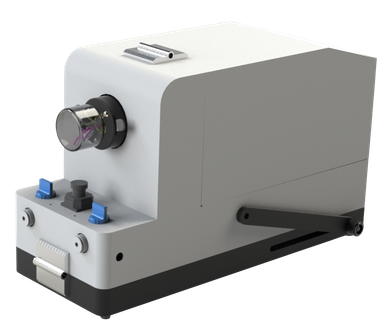
GT6 Discovery builds on the GT5 standard configuration (20-bottle rotator) with SunKP1, an independently pressurized single-bottle spinning perfusion module for continuous medium addition and exchange, dosing and rinsing. It also adds a cooling/heating module for media and buffers and at least two camera modules, for experiments that need medium exchange, dosing or perfusion during culture.
Specifications
| Item | WEC001-GT5 (standard) | WEC001-GT6 Discovery |
|---|---|---|
| 20-bottle rotator | DishKP5 pluggable single-axis rotator; aerospace aluminum alloy with antibacterial coating; numbered positions on both sides; inserting or removing a single bottle does not change system pressure | |
| Spinning perfusion module | Not included; the controller supports later module upgrades | SunKP1 ×1: independent pressure holding, 1 bottle position; multi-channel automated medium exchange, addition, dosing and rinsing; cooling/heating module; camera |
| Culture bottles | BottleKP2 thin-wall glass bayonet bottles ×60; wall 1 mm, bottom 0.5 mm; pressure rating ≥0.21 MPa; max. working volume 9 ml (15 ml optional) | BottleKP2 ×60; wall 1 mm, bottom 0.5 mm; pressure rating ≥0.21 MPa; max. working volume 9 ml |
| Rotation speed | 0–60 RPM in 0.1 RPM steps (display ±0.01 RPM); forward, reverse and pause | |
| Temperature | 10–50℃; ±0.1℃ stability at 37℃ | 10–50℃; ±0.1℃ stability at 37℃; plus cooling/heating for media and buffers |
| Pressure | 0.0–20.0 PSI in 0.1 PSI steps; 0.001 PSI resolution; adjustable pulsatile pressure difference | |
| Gas mixing | O₂ / N₂ / CO₂ each 0–100% (total 100%) in 0.1% steps; %wt and %vol modes; works with 40% or 99.99% O₂ supply; one-touch AI auto-calibration; gas purification filter bottle | |
| Gas monitoring | Optical sensors with real-time display; O₂ and CO₂ 0–100%vol; measured stability CO₂ ±0.1%vol, O₂ ±0.3%vol | |
| Gas flow | 8–100 ml/min with real-time display; precision ±0.01 ml/min | |
| Programs and curves | At least 10 parameter groups (gas ratio, pressure, speed and more) executed on a timeline; real-time curves of key parameters | |
| Imaging and remote access | EmbryoLive20 HD camera and communication module; covers at least 10 bottles; live view and parameter changes from phone or PC; time-lapse | At least 2 HD camera modules; covers at least 11 bottles; time-lapse imaging and video recording |
| Culture log | At least 100,000 records of time, gas concentration, flow, temperature, pressure and photos; export to Excel or ZIP | |
| Safety | Dual pressure-relief protection; chamber O₂ leak alarm with an adjustable 20–40% threshold | |
| Operation | 14-inch or larger HD touchscreen, usable with gloves; Linux operating system | |
| Built-in accessories | Humidifier bottle, bubble-check bottle, 3 standard gas inlets, 1 exhaust port, USB port, lighting, UV lamp, perforated shelf | |
| Power supply | 220 VAC ±10%, 50/60 Hz | |
| Operating environment | 15–37℃; relative humidity below 80% | |
| Dimensions and weight | All-in-one unit, up to 78 × 70 × 165 cm (L × W × H); up to 120 kg | |
| Price | Quoted per configuration. Contact us for a quote. | |
Specifications describe the instrument's operating range, based on the GT5 / GT6 technical specification sheets; they are not a validated culture protocol. The delivered configuration follows the technical agreement confirmed by both parties. Products are continually improved, and details may change without notice.
Culture vessels and accessories for the rotary whole embryo culture apparatus
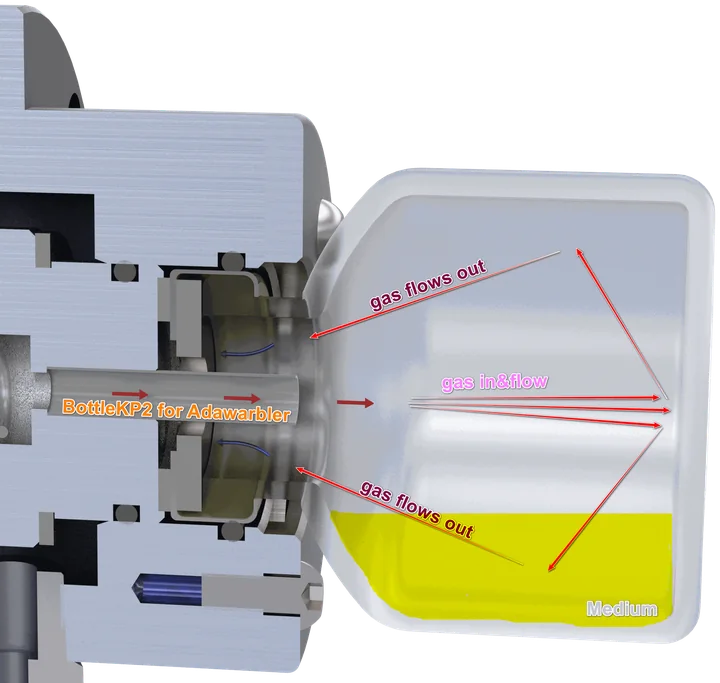
BottleKP2 bottles have a 1 mm wall and a 0.5 mm bottom for clear viewing and time-lapse imaging. A bayonet mount replaces the screw thread, so bottles can be fitted and removed quickly without heavy tightening.
Working volumes of 2 / 4 / 7 / 9 ml are available (15 ml optional), so the medium volume can match embryo number and stage. Silicone gaskets and metal caps can be autoclaved at 121℃.
Standard items
| Item code | Description | GT5 standard qty | GT6 Discovery standard qty |
|---|---|---|---|
| GT02-7 | DishKP5 pluggable single-axis rotator (orbiting), pressure-holding, 20 bottle positions | 1 | 1 |
| GT03-ZZ-1 | SunKP1 pluggable single-axis rotator (spinning), independent pressure holding, 1 bottle position; with spinning perfusion, cooling/heating and camera modules | – | 1 set |
| GT03-7-1 | BottleKP2 thin-wall glass bayonet culture bottle; wall 1 mm, bottom 0.5 mm; max. 0.21 MPa | 60 | 60 |
| GT03-7-2 | Ring sealing silicone gasket, autoclavable at 121℃ | 60 | 120 |
| GT03-7-3B | Ring sealing metal cap, blue, autoclavable at 121℃ | 200 | 120 |
| GT03-7-3G | Ring sealing metal cap, green, autoclavable at 121℃ | 200 | 120 |
| GT03-7-4 | Metal cap crimper | 1 | 1 |
| GT03-7-5 | Cap remover | 1 | 1 |
| 1856710 | TeslaGrip gripper for Adawarbler | 1 | 1 |
| GT08 | Dust plug | 20 | 20 |
Also supplied: maintenance tools, a φ6 mm exhaust tube, O-rings and mini wrenches for the gas channels. Bottles, gaskets and caps can be reordered separately, and larger custom bottles are available on request. Please contact us for prices.
Provided by the laboratory: O₂, N₂ and CO₂ cylinders or a central gas supply (O₂ can be replaced by 40% O₂ / 60% N₂), plus three two-stage pressure regulators (0–0.6 MPa, outlet for 6 mm OD tubing, push-in or screw fittings).
Background of the rotary method
Rotating culture of explanted rodent embryos was established by D.A.T. New and colleagues in the early 1970s. In 1979, New and Cockroft described a rotating bottle method with continuous replacement of the gas phase; researchers in Japan later refined this rotator system for organogenesis-stage embryos and applied it to studies of craniofacial development and neural crest migration.
WEC001 keeps the BTC (British Turntable Culture) principle of culture bottles mounted on a rotator, and replaces manual regassing with digital control of three gases, pressure, temperature and rotation, with every run recorded.
References
- New DAT, Cockroft DL. A rotating bottle culture method with continuous replacement of the gas phase. Experientia. 1979;35(1):138–140. doi:10.1007/BF01917926
- New DAT, Coppola PT, Terry S. Culture of explanted rat embryos in rotating tubes. J Reprod Fertil. 1973;35(1):135–138.
- Eto K, Osumi-Yamashita N. Whole embryo culture and the study of postimplantation mammalian development. Dev Growth Differ. 1995;37(2):123–132.
- Osumi-Yamashita N, Ninomiya Y, Eto K. Mammalian craniofacial embryology in vitro. Int J Dev Biol. 1997;41(2):187–194. PubMed 9184325
These publications are cited as methodological background; they did not use or validate WEC001.
Plan your whole embryo culture with us
Tell us the species and strain, explantation stage, embryos per run, culture duration, and whether you need imaging or medium exchange. A product specialist will recommend bottles, gas supply and a configuration, and prepare a quote.